From Evidence to Decisions: Montenegro’s REDEEM WEFE Workshop
Water management decisions affect food production, energy requirements, ecosystem conditions and people’s livelihoods. Bringing these connections into institutional practice is a central challenge of the water–energy–food–ecosystems nexus, or WEFE nexus.
On 26 November 2026, I facilitated Montenegro’s online territorial WEFE stakeholder workshop under the REDEEM project. The workshop brought survey evidence into a structured discussion about the barriers to integrated resource management and the practical measures stakeholders considered most useful.
The event formed part of Montenegro’s Ministry of Agriculture, Forestry and Water Management contribution to REDEEM, supported by E3 Consulting’s technical assistance.
My role: connecting analysis, dialogue and recommendations
As Key Expert and Team Leader, WEFE Nexus and Water Governance Expert, I coordinate technical delivery within E3 Consulting’s support to the Ministry. My responsibilities connect methodology, specialist contributions, stakeholder engagement, quality assurance and reporting.
For this workshop, my contribution focused on connecting the analytical preparation with stakeholder dialogue and the synthesis of findings. Working with the expert team, I helped ensure that the consultation addressed both the evidence behind the identified barriers and the conditions needed to respond to them.
During the event, I facilitated discussion across governance, access to finance, data and capacity, participation, water allocation and climate resilience. The aim was to translate broad concerns into practical questions: which responsibilities need clarification, what information users need and what could realistically be developed next.
Establishing a shared evidence base
The discussion drew on 29 completed stakeholder questionnaires. Policy and governance received the highest mean category rank, 4.17 out of 5, followed by market and finance at 3.28. Governance appeared among the top two categories for 23 of the 29 respondents.
These results provided a starting point for discussion. Higher ranks indicate greater relative importance within the questionnaire; they do not measure absolute barrier severity or physical drought risk.
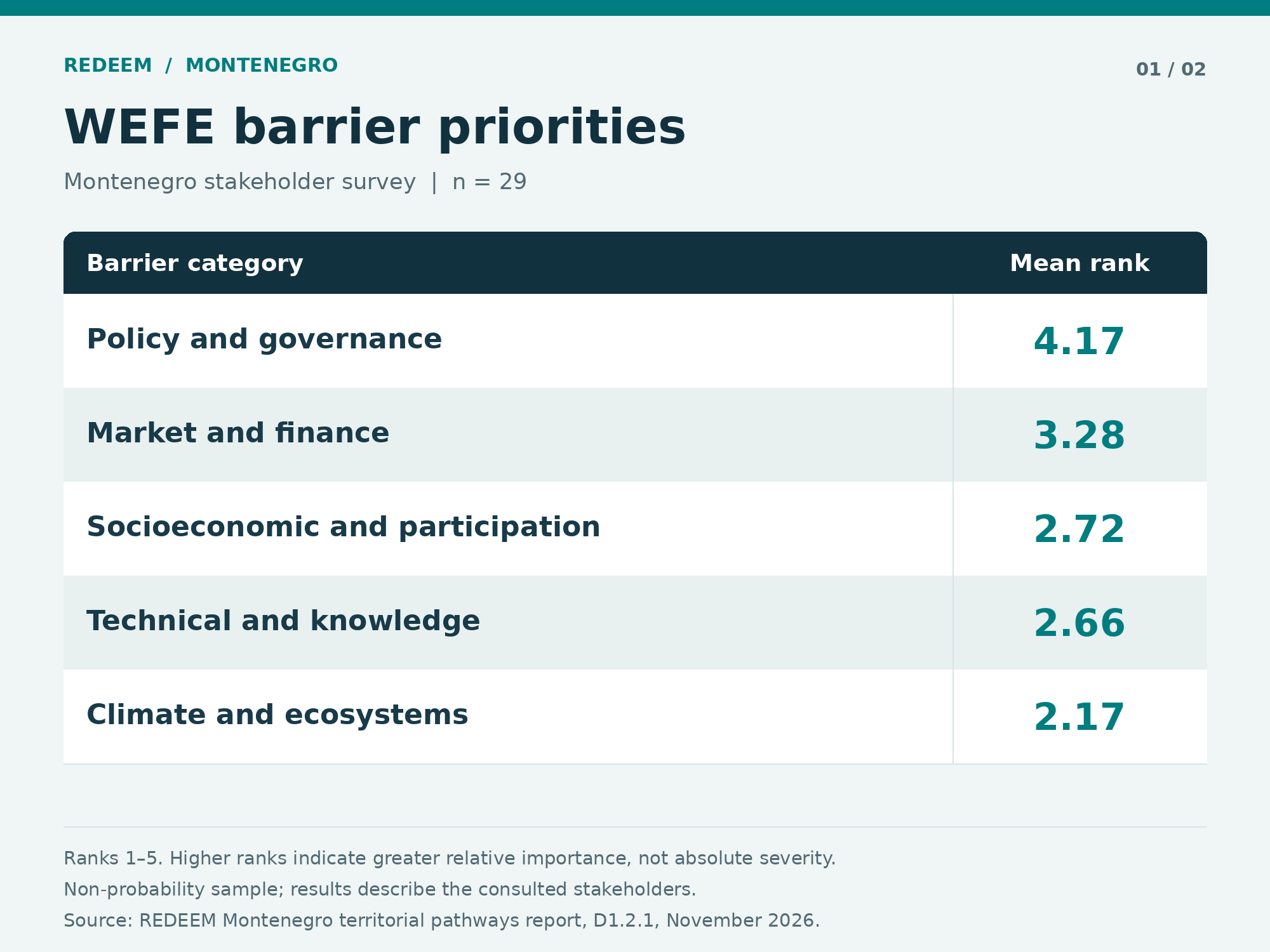
Relative importance of WEFE barrier categories in the Montenegro stakeholder survey. Higher ranks indicate greater relative importance; n = 29.
A workshop designed to move towards practical choices
The workshop combined presentation of the survey findings, independent anonymous responses through Mentimeter, facilitated discussion and a read-out of conclusions. Its 23-question sequence allowed participants to assess barriers, consider possible responses and identify priorities for further development.
Several findings sharpened the practical direction:
Nine of 13 respondents identified weak institutional coordination as the main governance barrier.
Eight of 13 preferred a clearer division of responsibilities as the most useful governance change.
Eight of 13 selected technical assistance for project and application preparation as the preferred financing support.
Nine of 14 favoured a shared register of harmonised data.
These findings connect institutional cooperation with everyday implementation needs. Clear responsibilities help information move between organisations, while usable evidence supports the preparation of credible investment concepts.
Shared data and training as an entry point
Shared data and training emerged as the leading action: eight of 12 respondents selected it for further development, and six of 11 chose it as the first measure to develop.
My interpretation is that this offers a practical task around which cooperation can begin. A defined water-scarcity or resource-use decision would give institutions and users a common purpose for identifying datasets, resolving inconsistencies and practising the assessment of options.
The territorial synthesis connects this starting point with clearer coordination, investment preparation, targeted participation and transparent allocation procedures.
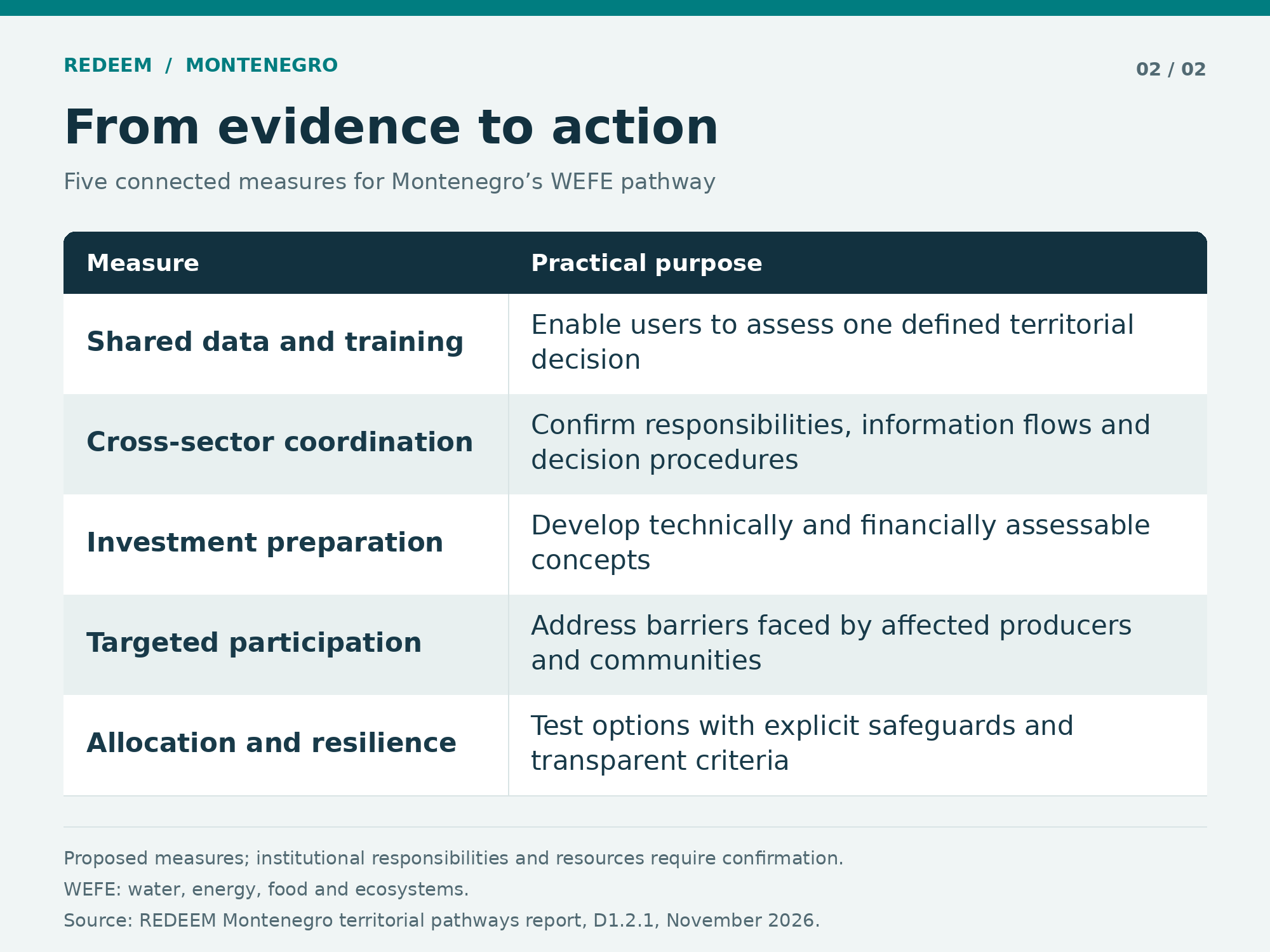
Five proposed measures connecting shared evidence, institutional responsibilities, investment preparation, participation and resilience. Implementation arrangements require confirmation.
Keeping affected users and ecosystems in the process
The discussion also highlighted participation constraints faced by small agricultural producers and the need for practical support to enable their contribution.
For me, this is an essential part of the governance task. A technically coherent proposal also needs to account for affordability, operating constraints and the distribution of costs and benefits. Producers and affected communities should contribute directly to that assessment.
Similarly, minimum human and ecosystem needs must remain explicit when examining competing water uses during scarcity.
From consultation to a testable next step
The workshop findings contributed to the preparation of Montenegro’s territorial report on pathways towards sustainable WEFE nexuses.
The proposed next step is to select one relevant territorial decision, confirm the competent institutions and data custodians, and develop a practical exercise using shared evidence. Investment preparation and participation arrangements can then be developed around that same decision.
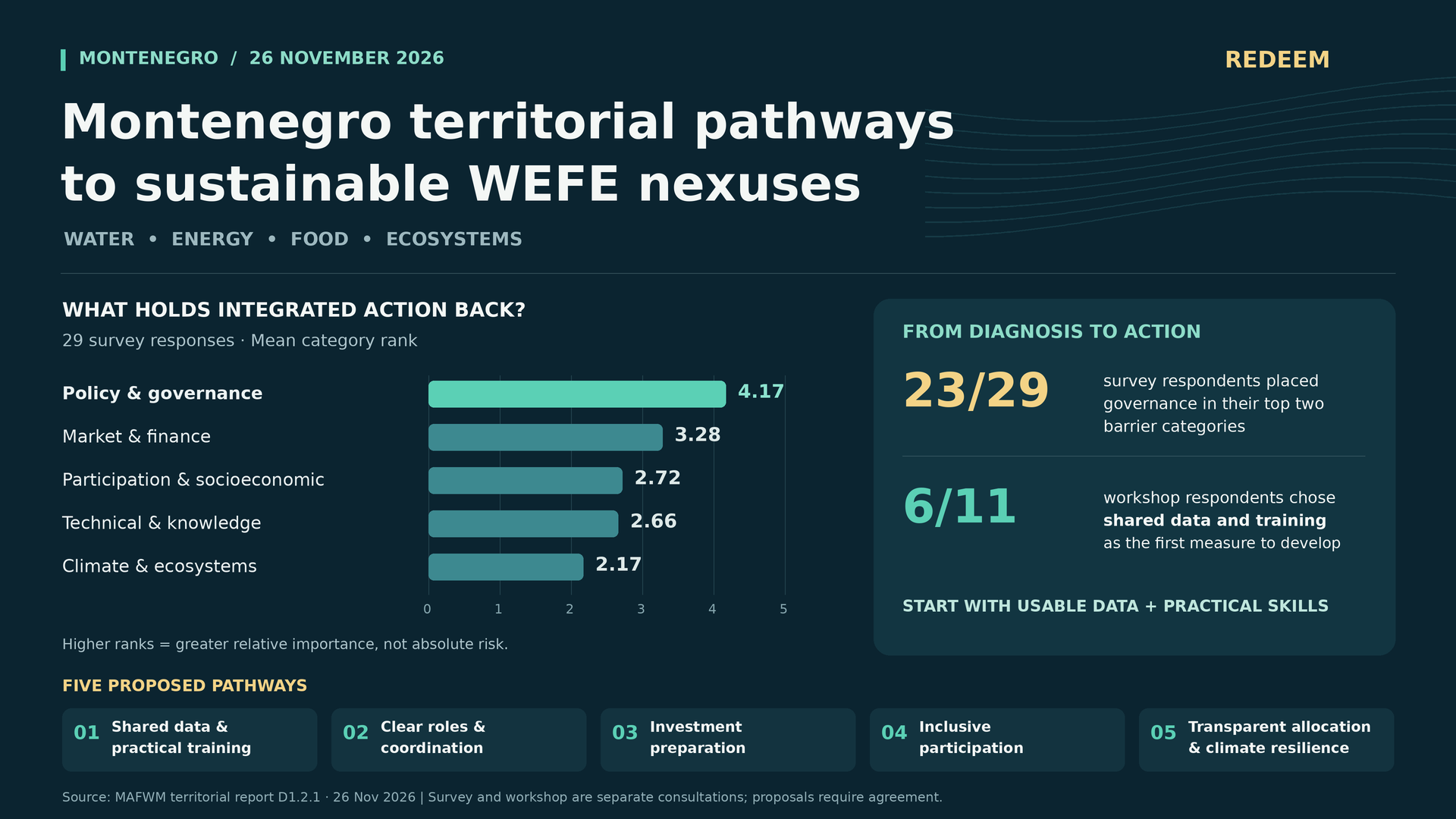
From evidence to decisions—connecting stakeholder knowledge with practical WEFE pathways in Montenegro.
The consultation provides a direction for further work. Its results describe the participating stakeholders, while institutional responsibilities, resources and implementation commitments require separate confirmation.
My contribution is to help make that transition concrete: connecting analysis with dialogue, and dialogue with recommendations that institutions and users can examine, refine and put into practice.
Related project: